 This is my floor plan for my celebrity kitchen design for client, William McDonough. The organization of space is very diverse and allows the kitchen to function in a very practical manor. The main traffic flow enters from the living room (on the bottom) and travels past my custom designed shelving unit to the right into the dining room. Or from the living room to the laundry/mudroom straight across, past the breakfast bar to the top of the drawing. None of these main paths will cross and bother the cook, which works around the inside of the "L"-shaped counter-space and the island. Originally, the plan included very narrow, standard door sizes to all of the surrounding rooms, however, I chose to expand the dining room and living room entrances to allow more of a connection between the spaces and allow for more natural light to flow from the large span of windows to the surrounding spaces. The overall layout I have created is very dynamic, diverse and functional -- the way a kitchen should be.

Showing posts with label design studio. Show all posts
Showing posts with label design studio. Show all posts
Wednesday, November 25, 2009
celebrity kitchen [floor plan]
This is my floor plan for my celebrity kitchen design for client, William McDonough. The organization of space is very diverse and allows the kitchen to function in a very practical manor. The main traffic flow enters from the living room (on the bottom) and travels past my custom designed shelving unit to the right into the dining room. Or from the living room to the laundry/mudroom straight across, past the breakfast bar to the top of the drawing. None of these main paths will cross and bother the cook, which works around the inside of the "L"-shaped counter-space and the island. Originally, the plan included very narrow, standard door sizes to all of the surrounding rooms, however, I chose to expand the dining room and living room entrances to allow more of a connection between the spaces and allow for more natural light to flow from the large span of windows to the surrounding spaces. The overall layout I have created is very dynamic, diverse and functional -- the way a kitchen should be.

celebrity kitchen [elevations]


 These cabinet wall elevations are of my celebrity kitchen design for client, William McDonough. The cabinets are all pull-out or drawers to make the kitchen more efficient than standard cabinets that you have to basically climb inside to get something. In addition to these easy storage options, I also designed a custom shelving unit with sliding doors for more storage. The shelves are only a foot deep, making it easier to grab items from it. This is a more dynamic style that I can see McDonough using. To further enhance a unique kitchen design, I chose the bold color red to create an even larger impact when someone was to walk into this space. Very bold. Very new. Very efficient.
Wednesday, May 13, 2009


Wednesday, April 8, 2009
light + geometric forms


For this project, we were to use light as an inspiration and as a main element to our design. We were then connect light to a celebration moment of our lives and a piece of nature that we found. My celebration was of a surprise party that was thrown for me when I was twelve, which connected with my nature piece which was a small, spiky ball that fell from a tree. I feel I had accomplished the feeling of excitement and spiky form through my abstract and random triangular shapes. As light shines through all the random forms, it casts interesting shadows on the bottom surface and on the structure itself. In my project, light even creates colors: shades of brown are reflected on the shapes. I also used skewers that originally were to help as supports, but I decided to use joinery with tension. Instead, the skewers were an added feature that further complimented the randomness, visual interest and light effects, connecting all forms in a way. I was extremely pleased the way my ideas came from my head, down to paper, and then to model form. If I were to critique my own project, I would say that I was successful at what I wished to achieve: light, form and celebration.
Tuesday, March 17, 2009
relating processes
[STORY + DESIGN PROCESS]
how similar can they be?
One might not immediately link writing a story to designing a piece of work. However, once looked at more closely, it is easy to relate the two processes. The design process and a story [process] are extremely similar. In a way, a design process tells a story. But to be more general, both the writing process and design process start simple and develop and build from previous ideas : there is always a beginning, middle and end.
BEGIN WITH THOUGHTS
For any story or design, it needs to start with an idea that will be able to develop. By brainstorming, a person can make a storyboard or grid layout that shows the process of the story or the ideas and meanings of a design. In a story, it is essential that the author have an initial theme. Without a theme, the reader is going to get bored and it will not be a success. Same as a design : a design must have a purpose or meaning that may be portrayed through symbolism.
BUILD A FOUNDATION
Research must be conducted and after general ideas have been set up, a foundation must be set. In a story, the reader must be informed in the beginning of characters, setting and point of view. These are the elements of a story, which mesh with the elements of design including an inspiration, a precedent and a design that is audience driven. Materials are gathered and a prompt is made for a new design. Each character in a story create the mood similar to how each design and designer has its own individual “character”. Also, most stories or designs are based off of something else, making precedents a great idea starter. Once this simple structure is established, a design or a story can develop further.
LEAD THE JOURNEY
Ideas then develop and change both in a story and through a design. Once a foundation is set, the characters in a story can build and head to the overall plot. In design, different models are constructed as critiques change ideas and revisions are always made. In both cases, the processes go through translation and problem solving occurs, as issues need to be fixed. Problems happen either in the overall meaning and craft of a design or the characters in stories battling a situation or a writer having an actual mental mind block. Sometimes flare is needed or exaggeration is beneficial as the expression of ideas may be weak. And I feel, the most important part of both processes is detail – if a designer or writer does not pay close attention to detail, the pieces loses potential and overall greatness.
CONTINUE TO CLIMAX
Details, flare and expression all lead up to the processes ultimate high. In stories specifically, the climax is the highest point of the story for the reader. Also reflected in design, it is the moment at which there is the greatest amount of interest and emotion. Every part of the story or design has now been well-crafted, interactive with audience and distinctly unified. Every piece of information has been communicated to the viewer without confusion and the concept is easily marked. The journey is coming to a close and in order to be successful, the final model or last sentence must reflect a sense of commodity, firmness and delight in both processes. This is the evidence of a well-designed process. This is the point in both processes at which the outcome of the conflict can be predicted.
DECEND TO END
The end for both a story and a design is the final viewing. A story is built to finally be complete and then be read by people, whereas a design is completed and then viewed by professors, fellow students or the community. A grade or review is then constructed giving feedback to the long, strenuous process of both creating a story and coming up with a design.
how similar can they be?
One might not immediately link writing a story to designing a piece of work. However, once looked at more closely, it is easy to relate the two processes. The design process and a story [process] are extremely similar. In a way, a design process tells a story. But to be more general, both the writing process and design process start simple and develop and build from previous ideas : there is always a beginning, middle and end.
BEGIN WITH THOUGHTS
For any story or design, it needs to start with an idea that will be able to develop. By brainstorming, a person can make a storyboard or grid layout that shows the process of the story or the ideas and meanings of a design. In a story, it is essential that the author have an initial theme. Without a theme, the reader is going to get bored and it will not be a success. Same as a design : a design must have a purpose or meaning that may be portrayed through symbolism.
BUILD A FOUNDATION
Research must be conducted and after general ideas have been set up, a foundation must be set. In a story, the reader must be informed in the beginning of characters, setting and point of view. These are the elements of a story, which mesh with the elements of design including an inspiration, a precedent and a design that is audience driven. Materials are gathered and a prompt is made for a new design. Each character in a story create the mood similar to how each design and designer has its own individual “character”. Also, most stories or designs are based off of something else, making precedents a great idea starter. Once this simple structure is established, a design or a story can develop further.
LEAD THE JOURNEY
Ideas then develop and change both in a story and through a design. Once a foundation is set, the characters in a story can build and head to the overall plot. In design, different models are constructed as critiques change ideas and revisions are always made. In both cases, the processes go through translation and problem solving occurs, as issues need to be fixed. Problems happen either in the overall meaning and craft of a design or the characters in stories battling a situation or a writer having an actual mental mind block. Sometimes flare is needed or exaggeration is beneficial as the expression of ideas may be weak. And I feel, the most important part of both processes is detail – if a designer or writer does not pay close attention to detail, the pieces loses potential and overall greatness.
CONTINUE TO CLIMAX
Details, flare and expression all lead up to the processes ultimate high. In stories specifically, the climax is the highest point of the story for the reader. Also reflected in design, it is the moment at which there is the greatest amount of interest and emotion. Every part of the story or design has now been well-crafted, interactive with audience and distinctly unified. Every piece of information has been communicated to the viewer without confusion and the concept is easily marked. The journey is coming to a close and in order to be successful, the final model or last sentence must reflect a sense of commodity, firmness and delight in both processes. This is the evidence of a well-designed process. This is the point in both processes at which the outcome of the conflict can be predicted.
DECEND TO END
The end for both a story and a design is the final viewing. A story is built to finally be complete and then be read by people, whereas a design is completed and then viewed by professors, fellow students or the community. A grade or review is then constructed giving feedback to the long, strenuous process of both creating a story and coming up with a design.
Wednesday, March 4, 2009
PORTAL : PANEL
The pictures that my group took of our portal, we shared between each other.
First 2 shots : detail + interesting


First 2 shots : detail + interesting


This is our first sketchmodel of our creation : idea
portal 118 : boundaries : contrast : positive / negative space : balance

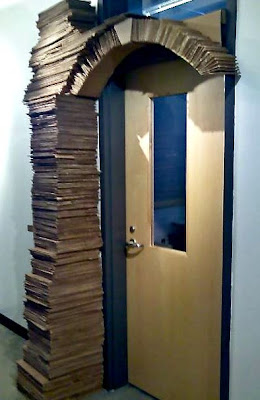


the hallway of portals : creation
the three-dimensional graphic that I created for our portal : mini column

Sunday, February 22, 2009
b+w: 3 models
As one of the processes of the black and white project, we were to create three models that reflected our first model and three design terms. My terms were CONTRAST, POSITIVE / NEGATIVE SPACE, and PROXIMITY.

Monday, February 16, 2009

Sunday, February 1, 2009
Fairytale Artifact

 The fairytale that I read and analyzed was "The Juniper Tree". For this assignment, we were to create a wearable artifact that reflects the essence of our stories. The essence of my story was karma, with the cycle of cause and effect, and the saying "what goes around comes around". In the story, the stepmother kills the stepson out of jealousy and in the end, the stepson comes back and kills her. For my artifact, I decided to symbolize a few point of the story. I chose to have my artifact be a ring , which commonly symbolizes marriage and love. However, this story is dark and evil, which is why I decided to spray paint my "ring" black. The ring is also made up of many curvy, circular designs resembling the main theme of karma, with the sizes varying from finger to finger to represent the heights of events. As you can see by the underside picture, I attached all four rings into one large ring per say. This action symbolizes the attachment of events.
Subscribe to:
Posts (Atom)